

I’m 17, and my left upper canine hasn’t erupted yet. The baby tooth is still there. My right baby canine came out when I was 14, but it took six months for the permanent one to erupt. Last year, my dentist said an X-ray showed all my adult teeth were present and that my small mouth was causing the delay. She thought this baby canine would come out soon, but it hasn’t loosened at all. Should I be worried? If I do lose the baby tooth before the adult one erupts, are there temporary options to fill the gap? – Thanks. Montana from FL
Montana,
A permanent canine tooth that has not erupted by age 14 should be evaluated. Most permanent canine teeth erupt between ages 10 and 12. When canines remain trapped beneath the gums, they are considered impacted. Early diagnosis provides the greatest opportunity to guide the tooth into its proper position.
Waiting too long can reduce the options because an impacted canine may fuse to the surrounding bone, making orthodontic movement impossible and leaving extraction as the only treatment.
Can Removing the Primary Canine Tooth Help?
Sometimes, removing the primary canine tooth can help. A panoramic X-ray can show the position of the permanent canine and whether its root is still developing. If the root is not fully formed, the tooth may still have enough eruptive force to come in naturally once the path is cleared.
Removing the primary canine may create enough space for the permanent tooth to erupt, especially if the tooth is already close to the surface. Even if treatment was not started earlier, this option may be effective, depending on the X-ray finding.
If the baby tooth is loose, the permanent canine may be positioned just beneath it.
What Information Is Needed Before Choosing Treatment?
The best treatment for an impacted canine depends on its position and development. An orthodontic evaluation, along with a panoramic X-ray, can provide the information needed to make that decision.
The examination should determine:
- Whether the permanent canine’s root has fully formed
- Whether the tooth still has natural eruptive force
- How close the tooth is to the gum surface
- Whether removing the baby tooth could help
- Whether orthodontic treatment is needed to guide the tooth into place
Should a Replacement Tooth Be Placed Right Away?
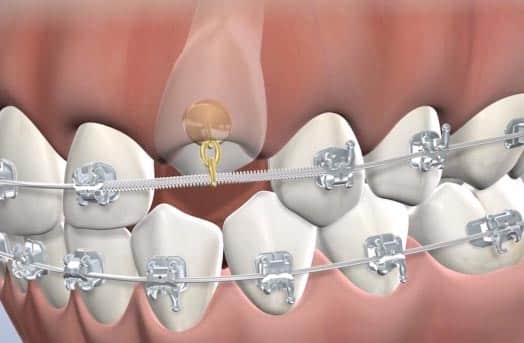
(Image courtesy of Manhattan Oral Surgery & Implant Center)
If the permanent canine still has a chance of erupting, it should not automatically be removed and replaced. Replacing the missing tooth too soon could interfere with the permanent canine’s path. It is best to determine whether the natural tooth can still be repositioned. If a canine needs help to erupt, an orthodontist or surgeon can fully expose it, then place a bracket on it as shown in the picture. A chain with a spring is attached to the bracket. As the canine erupts, the dental professional will shorten the chain, link by link, until the tooth fully erupts. The process can take a year.
Dr. David Pumphrey, an Atlanta periodontist, sponsors this post.