

I don’t go to the dentist much, mostly because they terrify me. However, lately, I’ve noticed my gums seem to be disappearing and going upward. Is this a dental emergency? My gums look healthy other than that. They’re the right color and I’ve only had one cavity in my entire life. I don’t know what’s going on.
Amber
Dear Amber,

You Don’t Have to Fear the Dentist
It sounds like you’re describing receding gums. There are several causes for this. The two main ones are gum disease and aggressive brushing.
A Dentist Can Help Find the Cause of Recessive Gums
Gum Disease
A dental exam can tell you right away if the cause is gum disease. This is the most serious reason for gum recession and it needs to be addressed as quickly as possible. If left untreated, it will lead to your teeth becoming loose and falling out. Then, you’ll need tooth replacement procedures such as dental implants.
I do realize you have dental anxiety. I’d like to help you with that. There are quite a few dentists these days who offer dental sedation. It is a huge help to patients who would rather be anywhere else than a dental chair. It’s so helpful, in fact, that many patients simply sleep through their appointments. Finding a compassionate sedation dentist can switch dental appointments from being something you dread to a time where you look forward to a nice nap.
Aggressive Brushing
If you use a hard bristled brush or press down too hard while brushing your teeth, this can also cause your gums to recede. It wears them down a little at a time.
Pinhole Technique to Restore Gums
There’s a fairly simple solution to restore your gums. There’s a pinhole gum surgical technique which is scalpel-free and suture-free. It’s patient-friendly and you can get back to your life much quicker because you don’t have the same type of healing time needed with more traditional surgical techniques.
This blog is brought to you by Dr. David Pumphrey.
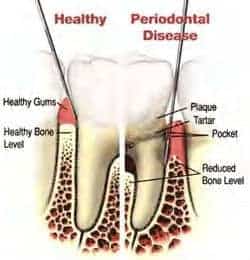 In the early stages, the gums can become inflamed or infected, and as it progresses, the inflammation spreads to the bone structures that support the teeth, leading to gum recession and bone loss. The diagram on the right shows this progression from a healthy tooth with full gum and bone support on the left to a diseased tooth on the right where the gum has receded, along with the bone.
 The pinhole surgical technique was invented and patented by Dr. John Chao, DDS, MADG, of California. It is a procedure that doesn’t involve scalpels, sutures or grafts. Instead, a small hole is made and specially designed instruments are used to work with the gum tissue that is already present. It is first loosened and then glided to cover the tooth more completely. Most patients experience very few post-operative symptoms like pain, swelling, and bleeding. And unlike the long healing period needed for traditional gum surgery, healing is quick and the results are immediate.
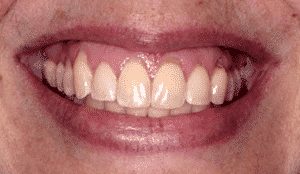
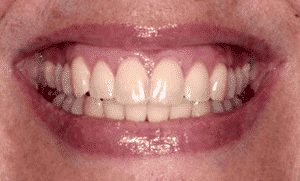 The photos on this page show a patient with recessed gums before and after the use of the pinhole surgical technique. In the before photo, several teeth are exposed by recessed gums, and in the after photo, the gums look as though they have always covered these same teeth naturally.